Chouara Tannery in Fes: How to Visit, What to Expect & Practical Tips
The Chouara Tannery is the most photographed spot in Morocco — and probably the most misunderstood by first-time visitors.
Quick Answer: The Chouara Tannery is inside Fes el-Bali and is viewed from terraces belonging to the leather shops surrounding it. Access is technically free but you will pass through a shop and may be offered leather goods afterward. You can visit without a guide and without buying anything.
This guide explains exactly how the visit works, what to expect from the shop system, the best time to come, and how to approach buying leather goods — or politely decline.
What Is the Chouara Tannery?
The Chouara Tannery (also known as Dar el-Dbagh) is the largest and oldest of Fes’s three remaining active tanneries. It has been in continuous operation for approximately 1,000 years, with the current location documented from at least the 11th century onward.
The tanning process is entirely manual — no modern machinery is involved. Workers handle raw hides from cows, sheep, goats, and camels, processing them through a sequence of stone vats:
- White vats (soaking/liming): Hides soak in a mixture of water, quicklime, salt, and pigeon droppings. This removes hair, softens the hide, and prepares it for dyeing.
- Color vats (dyeing): Natural dyes are used — saffron for yellow, poppy for red, indigo for blue, and henna for orange tones.
- Drying: Finished leather is spread on surrounding rooftops and flat surfaces to dry in the sun.
The visual result — a sea of circular pits vivid with color, surrounded by the medieval rooftops of Fes el-Bali — is genuinely spectacular.
The Workers: Context Worth Having Before You Visit
Most visitors arrive at the Chouara Tannery focused on the photography. Few spend much time thinking about the people standing knee-deep in the vats.
The tannery employs several hundred workers, the majority of whom come from rural areas of Morocco — the Rif mountains, the Souss valley, the Saharan south. Tanning is physically demanding work: long hours in caustic lime solutions, exposure to ammonia and natural dyes, repetitive manual labor in a confined industrial space. The work is not seasonal — it runs year-round.
At the same time, Chouara leather goods compete directly with industrially produced alternatives from China and Southeast Asia that cost a fraction of the price. The tannery survives largely because the finished product — vegetable-tanned, hand-processed Moroccan leather — still commands a premium among buyers who understand what they are getting.
This context does not obligate you to buy anything you don’t want. But understanding it shifts the tannery from “a colorful tourist photo opportunity” into something more honest: a working-class industrial tradition that is economically precarious and genuinely worth preserving.
How the Visit Actually Works
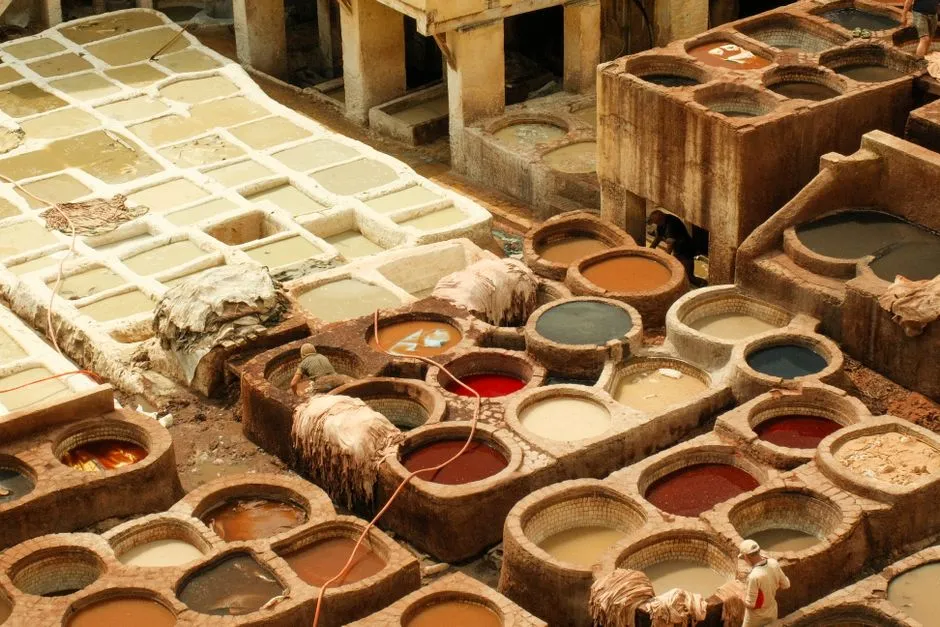
This is what most travel content glosses over: there is no dedicated public viewing platform. The tannery is surrounded on all sides by leather shops, and the only way to see the pits properly is to go up to one of their terraces.
The typical sequence:
- You approach the tannery area (near the Charabliyin Mosque).
- A man at a leather shop entrance offers you a sprig of fresh mint and invites you upstairs to see the tannery.
- You go up, take photos, and spend 20–40 minutes on the terrace.
- When you come down, you pass through the showroom — bags, slippers, jackets.
- A salesperson starts showing you items.
The mint is practical, not decorative. The white pits produce a powerful ammonia smell from the pigeon droppings. Hold the mint near your nose — it genuinely helps.
You are not obligated to buy anything. The viewing arrangement is informal. If you choose not to purchase, leaving a small tip (around 10–20 MAD per person) for the guide who showed you up is considered the polite approach.
How to Handle the Shop (Without Awkwardness)
The shop experience is scripted and the staff are accustomed to visitors who don’t buy. You don’t need to be apologetic or defensive.
If you are not buying:
- A simple “Merci, je regarde seulement” (French: “Thank you, I’m just looking”) or “Just browsing, thank you” in English works.
- Say it once, calmly. Don’t repeat it or over-explain.
- Leave. No further obligation.
If you do want to buy:
- Quality varies significantly between shops — inspect stitching and leather feel before committing.
- Prices are negotiable in most shops. The opening price is typically much higher than what the seller will actually accept.
- Simple items like babouche slippers and belts are easier to evaluate quickly than bags or jackets.
- If in doubt, the same leather goods are available at lower pressure in the regular souks along Talaa Kebira.
Note on pricing: We deliberately avoid publishing specific price tables here. Leather prices at Chouara vary widely based on the item, the shop, the quality of the hide, and the negotiation. Any table of “realistic prices” would be out of date within a season. The best approach is to compare prices across two or three shops before committing to anything.
How to Assess Leather Quality on the Spot
If you are thinking about buying, these are the checks you can do quickly in the shop, without any specialist knowledge.
1. The smell test. Genuine vegetable-tanned leather has a rich, earthy smell — slightly woody, slightly animal. It is not unpleasant. Cheap chemically processed leather often smells sharp, plasticky, or strongly chemical. If a leather jacket smells like a new synthetic raincoat, that is worth noting.
2. The bend test. Take a small section of the leather (a corner, an edge) and fold it gently. Quality leather creases softly and springs back. Very stiff leather was under-processed. Leather that crinkles into permanent fine lines is thin and will not age well.
3. The back of the hide. Turn the item over and look at the flesh side (the underside of the leather). On good quality leather it feels slightly velvety and has a consistent texture. On poor quality leather it may feel rough, flake, or show visible processing marks.
4. The stitching. Hand-stitching, by definition, is not perfectly uniform — but it should be tight, even in tension, and not pulling the leather at the stitch points. Loose stitching or puckered seams around handles and straps are signs of rushed construction.
5. Simple vs complex items. A belt or a pair of babouche slippers is easy to evaluate in two minutes. A handbag or jacket involves more variables — lining, hardware, structural stitching — and is harder to assess under pressure. If you are considering a larger purchase, there is no obligation to decide on the spot. You can leave, think about it, and return.
One category to approach carefully: Leather jackets. The price point is high, fit is hard to judge quickly, and the quality range is enormous. If you are serious about buying one, do not make that decision in the tannery showroom on your first visit. Come back on day two with a specific idea of what you want.
Where to View the Tannery
The main terraces are concentrated on the northern edge of the tannery (near the Charabliyin Mosque entrance). These offer the best full panoramic view of the pits and are the most accessible.
Secondary terraces exist on the eastern side but give a partial angle-view rather than the full panoramic layout.
Photography tips:
- Mid-morning light (from the south and east) illuminates the color pits well. Afternoon light is harsher and less useful for photography.
- Workers will sometimes request a small tip if you photograph them directly and close-up. This is reasonable — use your judgement.
- The view from the terrace is better with a wide or standard lens. Telephoto is less useful here.
When to Visit
Best overall: Spring (March–May) and early autumn (September–October). The tannery operates at full capacity, natural light is favorable, and the smell — while always present — is not amplified by summer heat.
Avoid: Summer afternoons (July–August). Heat intensifies the ammonia smell significantly, and some workers take extended breaks during the hottest hours, leaving pits partially inactive.
Avoid: Friday visits if you want to see the tannery at full activity. Work slows on Fridays for prayer.
Morning vs afternoon: Mid-morning is generally better — workers are most active, dyes are freshest, and the terraces are less crowded than after 11 AM when tour groups arrive.
How to Get There
The tannery is not easy to find on your first day. Google Maps is unreliable inside the medina. The clearest independent route:
- Enter Fes el-Bali through Bab Boujeloud (the Blue Gate).
- Walk down Talaa Kebira (the wider of the two main streets) for approximately 15–20 minutes, heading toward the Karaouine Mosque.
- Look for the tannery signage — it is reasonably well-marked along the main route.
- You will notice the smell before you see any sign.
For a complete guide to navigating Fes el-Bali, including the two main street routes, offline map options, and landmark orientation tips, see our Fes Medina Navigation Guide.
The Three Tanneries of Fes
Most visitors only know about Chouara, but Fes has two others:
- Chouara (Charabliyin): The largest and most visited. The one in all the photos.
- Ain Azliten: Smaller, near the mellah (Jewish quarter). Fewer visitors, generally quieter shop environment.
- Sidi Moussa: Specializes in sheep hides. Harder to locate without local knowledge.
For the full tannery experience, Chouara is the destination. The others are worth knowing about if you prefer a quieter visit or want to see a more residential part of the medina.
A note on “smaller = less pressure”: This is roughly true for Ain Azliten but should not be taken as a guarantee. Any tannery viewing arrangement involves leather shops. The dynamic is similar — the scale is just smaller.
Combining with Nearby Sights
The tannery sits in a part of the medina that contains some of Fes’s most important sights. A logical order from Bab Boujeloud:
Bab Boujeloud → Bou Inania Madrasa → Talaa Kebira → Chouara Tannery → Al-Attarine Madrasa → Attarine Souk
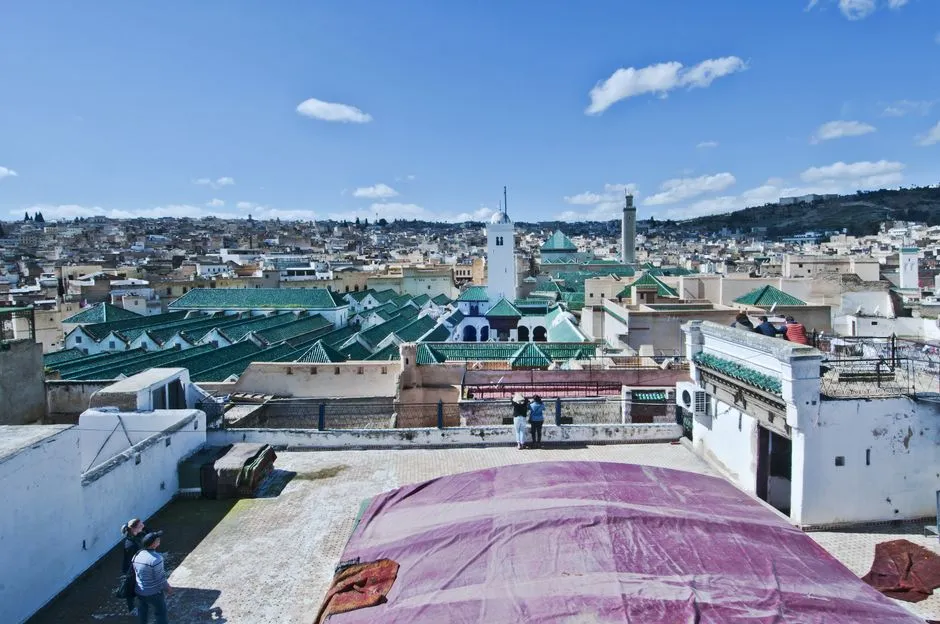
Allow around half a day for this route. None of the timings need to be exact — the medina rewards wandering, and the key landmarks are close enough together that you can adjust as you go. The Bou Inania Madrasa is a good first stop to orient yourself with Fes’ architectural style before the more intense tannery environment.
Frequently Asked Questions
Is there an entry fee for the Chouara Tannery?
There is no official ticket or formal entry fee. Access is through the terraces of surrounding leather shops, which is informal and technically free. If you don't make a purchase, leaving a small tip for the person who showed you to the terrace (around 10–20 MAD) is considered appropriate.
Do I need a guide to visit the Chouara Tannery?
No. You can find the tannery independently using the route description above. That said, a licensed guide for your first day in Fes makes the overall medina experience much smoother — they know which terrace gives the best view and can handle the shop interaction on your behalf if you prefer.
What is the best time to visit?
Mid-morning (roughly 9 AM–noon) when workers are active, the colors are vivid, and the light is favorable for photography. Avoid Friday afternoons and summer midday visits.
Is the smell really that bad?
It can be very strong, particularly in warm weather. The white liming pits produce ammonia from the pigeon droppings. The mint sprig shops provide genuinely helps. Most visitors adapt within a few minutes. If you are especially sensitive to smells, a short visit is perfectly acceptable.
Can I photograph the tannery workers?
You can photograph the tannery itself freely from the terraces. If you photograph workers directly and close-up, it is appropriate to ask permission and offer a small tip. This is generally welcomed.
Conclusion
The Chouara Tannery delivers exactly what the photographs promise — provided you understand the system before you arrive. The shop terrace arrangement is not a trap; it is simply how access works. Knowing this in advance removes the awkwardness and lets you focus on what is genuinely one of the most remarkable working craft sites in the world.
For more on planning your time in Fes, return to the main Fes Travel Guide.